How Google Cloud is helping U.S. Olympians go bigger with AI

Sarah Kennedy
Vice President, Marketing, Google Cloud
Building an experimental training tool so athletes from the U.S. Ski & Snowboard freestyle teams can gain a whole new perspective on their sport, and themselves.
On a sunny afternoon a few days before Christmas, American snowboarding legends Shaun White and Danny Kass and up-and-coming star Maddie Mastro, had just finished another run down a pristine half-pipe on the slopes of Copper Mountain, nestled deep in the Colorado Rockies.
At the base, this trio of U.S. Olympians looked down through their goggles at a tablet, watching videos of themselves performing nearly impossible tricks: a Haakon flip, frontside 1080, and Mastro’s signature double crippler. This wasn’t the usual filming for social media feeds or highlight reels, though.
They were shooting for a much bigger stage.
The videos — showing their bodies twirling through the air, pulsing with digital white dots — had just been analyzed by a new training tool developed by Google Cloud. It’s designed to use a suite of Google’s AI models to help elite athletes, including those from U.S. Ski & Snowboard, elevate their tricks and boost their confidence through a deeper understanding of the physics and biomechanics of each maneuver. Mastro smiled as she watched.
"I want my snowboarding to look really graceful,” she said, “more fun to watch and smoother. That's kind of my goal constantly.”
She pointed to the tablet, where the tool had just calculated stats like her peak rotational velocity and total air time simply by “watching” the footage. “This is highlighting a spot that, on a trick, I'm doing it very well, but there's a place that I can improve and make it look better,” Mastro explained.
Traditionally, high-precision motion capture requires specialized suits and controlled laboratories. This experimental prototype — built with a combination of the multimodal reasoning capabilities of Gemini and Google DeepMind’s advanced computer vision research — turns a standard smartphone into a professional biomechanics lab and pocket trainer.
With the Olympic Winter Games on the horizon in Italy, the tool is creating a lot of buzz on the U.S. freestyle skiing and snowboard teams. While it's still new, AI tools like Google’s offer an opportunity to enhance athletics going forward.

Mastro using the new Google Cloud training tool at Cooper Mountain, Colorado.
Alex Hall, one of the winningest American freestyle skiers in history, including an Olympic gold medal at Beijing 2022, marveled at the possibilities for his own runs using the tool. “Different data points can help you understand if you're close to that limit,” Hall said. “Instead of just going off gut feeling, which has worked great in the past, you can see the data and go a little bigger.”
Whether it’s athletes competing at the highest level, artists exploring impossible realms, researchers chasing breakthroughs across disciplines, or office workers making the most of their day, AI is increasingly about finding every edge — and even leaping beyond.

Athletes training models training athletes
When the Google Cloud team set out to build an AI performance tool for U.S. Ski & Snowboard athletes, they quickly discovered they’d have to bring their A-game, too.
Walking, singing, swimming, or pulling a 2340 off a 75-foot jump may be automatic for those who can do such things. When it comes to machine learning, real-world physics and biology remain some of the most complex computational challenges..
“Slow moving things, like walking down the street, are very, very easy for a model to visualize,” explained Katherine Larson, a Google Cloud AI solutions architect who worked on the U.S. Ski & Snowboard project. “When we're looking at these more complicated sports, these action-packed sports where so much happens within just one split second, that's where the technology is really groundbreaking.”
Like the aerial maneuvers themselves, the Google Cloud tool is far more complex than it appears on the surface. The system is built on the increasingly common foundation of orchestrating multiple advanced AI models working in relay across the cloud.
Before the tool was ready for use, the models had to do some training of their own.
Google Cloud worked closely with Team USA and U.S. Ski & Snowboard to fine-tune Google DeepMind’s model on a diverse range of elite performance data. This included processing hundreds of hours of footage from specific athletes like Mastro, Hall, and Colby Stevenson, a Team USA freeskier who won an Olympic silver medal at the Beijing 2022 big air competition. This helped the tool better understand athletes’ biomechanics, the way they moved through the physical world, and the particulars of each sport.
With the tool in hand, each session starts with Google’s Gemini model “watching” the raw incoming footage of a routine. Using its multimodal vision capabilities, Gemini identifies the specific athlete, detects their stance, and generates precise bounding boxes to track them across the frame. It then intelligently trims the video to isolate the exact window of airtime for analysis.
These action-packed sports where so much happens within just one split second, that's where the technology is really groundbreaking.
Once the clip is prepped, the Google DeepMind model takes over, utilizing frontier research in 3-D pose estimation from monocular (i.e two-dimensional) moving images. This layer infers a full skeletal pose in three dimensions from the flat video and can even track joint positions when limbs are hidden from the camera view. Detailed 3-D reconstructions like these are critical for accurately measuring factors like “cork” mechanics — the complex off-axis rotations that define modern snowboarding.
Finally, Gemini returns as the reasoning engine. It synthesizes changes in the 3D poses to calculate actionable metrics, such as rotational velocity and cork angle. This comprehension, alongside Gemini’s native natural-language interface, is what allows coaches and athletes to query the processed videos and information conversationally.
Chatting with a trainer in your pocket
In less time than it takes to ride the lift back to the top, users of the Google Cloud tool have a complete analysis of each trick, how it compares to past efforts, and a dizzying array of notes and pointers on what could be better next time.
“Just the ability to know how different some of these tricks are, and maybe it's the same trick, it feels the same, but then have all these different data points tell you it isn't — it’s interesting,” Stevenson said. “And then to be able to ask, ‘O.K., what felt different about that? What made it come out with different numbers?’”
Another big trick was making the platform technologically lightweight, so it can still run on the smartphones and tablets snowsport athletes already use in their day-to-day trips to the mountain.
“I think it’s really cool that any athlete can show up with a phone and hand it to someone across the way, and really start to understand and digest the information of where they're at,” said Kass, an Olympic silver medalist in half-pipe at Salt Lake City 2002 and Torino 2006 who now coaches Mastro and other snowboarders on the national team.


It's a multi-step process for Google's AI models to turn a real-world trick into detailed analysis. But it only takes minutes to do what was previously impossible.
White, a five-time Olympian and three-time gold medalist, likens the tool to the emergence of cellphone video more than a decade ago. Suddenly, he could watch a trick someone had just done — whether on the other side of the mountain or the other side of the world — and even if it was brand new, he could break it down almost frame-by-frame.
“That wouldn't have happened if we didn't have access to this footage,” White said. Now, “adding this extra information in, of how fast was I going, how high did I go, how much airtime was I getting — it’s a numbers game. It’s going to make a world of difference for these athletes now.”
Still edgy, more safety
While the primary reason for developing the tool was to improve athlete performance, safety came in a close second.
“We're in a sport where there's fear and other elements happening,” Mastro said. “To be able to have a little validating reminder of data, like — no, you're doing this right, you're doing this safe, your mechanics are good, you're ready for that next step — is sometimes necessary.”
Anouk Patty, the chief of sport for U.S. Ski & Snowboard, stressed how crucial safety is not only to keeping athletes safe but also protecting their dreams, and those of their teams.
“Athlete safety is our number one priority for sure,” Patty said. “If we could reduce the injury rate, our performance would go up significantly. When you lose a top athlete, it takes a while to get one to come up the pipeline to be able to replace them."
She noted that in a program with more than 240 athletes, 40 to 50 at a time can be sidelined by injuries. For some, injuries have been career ending.
“What Google’s tools can do for us, we’ve talked about the importance of the skeleton and being able to see where they're leaning too much on one side versus the other, or as they're using the shoulders for rotation,” Patty said. “Being able to see that will really help the coaches to sort of mitigate some of the injuries that we sometimes face.”
Google Cloud joins the team
As recently as the last Winter Olympics, almost no one had heard of generative AI or LLMs or the role they could play in sports. Looking at Google Cloud’s work with athletes and teams it has partnered with over the past 12 months, it’s easy to see all that’s possible today, both on and off the field.
Similar to his skiing and snowboarding compatriots, American golfer Bryson DeChambeau was an early adopter of AI-assisted video analysis, using it to dissect his golf swing in the most minute detail. It was AI that helped DeChambeau identify an imperceptible pelvic motion that was hooking some shots — a detail that had eluded him and his coaches.


Stevenson and Hall (center and right, top photo) and Mastro and White (left and center left, bottom photo) testing out the training tool with the Google Cloud team.
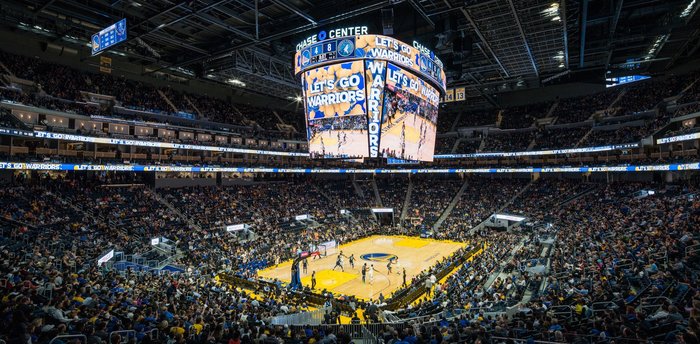
With Stephen Curry, the renowned all-star point guard, Google Cloud created a database of every one of his plays through the 2025 season, which could be queried for stats in exhaustive detail to help with future training or game-time choices. Curry’s team, The Golden State Warriors, also partnered with Google Cloud to build a similar set of AI systems to evaluate many back-office decisions.
Drivers and team leaders at McLaren Racing have partnered with Google to help analyze needs as varied as new chassis designs to weather predictions for optimum tire choice, while England’s Football Association, another Google partner, counts on AI to make better line-up decisions for players on the national soccer teams that don’t often get to play or practice together.
MLB, through its partnership with Google Cloud, has become one of the most AI-adept sports leagues, creating tools and platforms to analyze plays, study changes to the game, build highlights for fans, and even automate the monitoring of broadcast feeds.
AI tools like Google’s could even bring new kinds of viewing and experiences to fans — some of which may yet debut at this year’s Olympic Winter Games.
Above and beyond the podium
While U.S. Ski & Snowboard athletes are just starting to push the boundaries with Google Cloud’s tool, the team who built it and their partners at Google DeepMind are busy themselves, exploring new frontiers for advanced 3D modeling beyond athletics.
They’re already studying applications for these AI systems across robotics, healthcare, manufacturing safety and monitoring, biosciences, quality control, smart cities, and other fields where the analysis of complex motion could have significant societal benefits.
“If we can crack this code,” Larson, the Google Cloud engineer, said, “then I think there's a lot of other sports and industries that you can break into.”
For now, let’s sit back and enjoy the games.